<?xml version="1.0" encoding="utf-8"?><feed xmlns="http://www.w3.org/2005/Atom" ><generator uri="https://jekyllrb.com/" version="3.10.0">Jekyll</generator><link href="/feed.xml" rel="self" type="application/atom+xml" /><link href="/" rel="alternate" type="text/html" /><updated>2024-11-21T19:13:51+00:00</updated><id>/feed.xml</id><title type="html">Nicholas Bishop</title><subtitle>&apos;Machine Learning and ABMs...&apos;</subtitle><entry><title type="html">Interventionally Consistent Surrogates for ABMs</title><link href="/2024/11/02/interventional-surrogates" rel="alternate" type="text/html" title="Interventionally Consistent Surrogates for ABMs" /><published>2024-11-02T00:00:00+00:00</published><updated>2024-11-02T00:00:00+00:00</updated><id>/2024/11/02/interventional-surrogates</id><content type="html" xml:base="/2024/11/02/interventional-surrogates"><![CDATA[<p>This blog post outlines a recent paper which I worked on with my fantastic collaborators Joel Dyer, Fabio Zennaro, Yorgos Felekis, Theo Damoulas, Anisoara Calinescu and Mike Wooldridge. This work is set to be published at NeurIPS 2024 - check out the full paper <a href="https://arxiv.org/abs/2312.11158">here</a>!</p>

<h2 id="abms-and-the-need-for-surrogates">ABMs and the Need for Surrogates</h2>

<p>As micro-data becomes increasingly available, agent-based modelling becomes an increasingly attractive framework to model and analyse complex systems. Since agent-based models (ABMs) simulate systems at the agent level, they allow us to investigate exceptionally fine-grained policy interventions. Additionally, unlike machine learning models such as neural networks, one can readily incorporate domain knowledge that may not be represented explicitly in data.</p>

<p>Unfortunately ABMs are often computationally expensive to run and difficult to integrate into machine learning pipelines. Moreover, they often produce complex individual-level outputs that are difficult to analyse. In practice, we often want to reason about a complex system at the macro-level, in terms of its emergent properties.</p>

<p>This motivates us to pursue surrogate models which</p>
<ul>
  <li>are computationally cheap to run</li>
  <li>easy to integrate into existing ML pipelines</li>
  <li>and reason at the macro-level.</li>
</ul>

<h2 id="abms-as-causal-models">ABMs as Causal Models</h2>
<p>An ABM implcitly defines a <a href="https://github.com/csquires/6.S091-causality/blob/main/lecture_notes/Lecture1.pdf">structural causal model</a> (SCM) that specifies how agents interact with each other and the environment. Unfortunately, we rarely have explicit access to this SCM, and even if we did, it would be tremendously large. This is in part why we encounter the issues described above with ABMs, and why reasoning causally about ABMs is difficult. Our lives would be made far easier if we had access to a simple causal surrogate model that is interventionally consistent with the original ABM. This line of thought leads naturally to causal abstraction theory!</p>

<h2 id="causal-abstraction-theory">Causal Abstraction Theory</h2>
<p>Causal abstraction theory aims to relate two structural causal models defined over different sets of variables. There are many frameworks for causal abstraction. In this work we use \(\tau\)-\(\omega\) abstraction. Investigating the formal connections between different abstraction frameworks constitutes an interesting research direction, and you should check another of Fabio’s <a href="https://arxiv.org/abs/2207.08603">papers</a> if you are curious about it!</p>

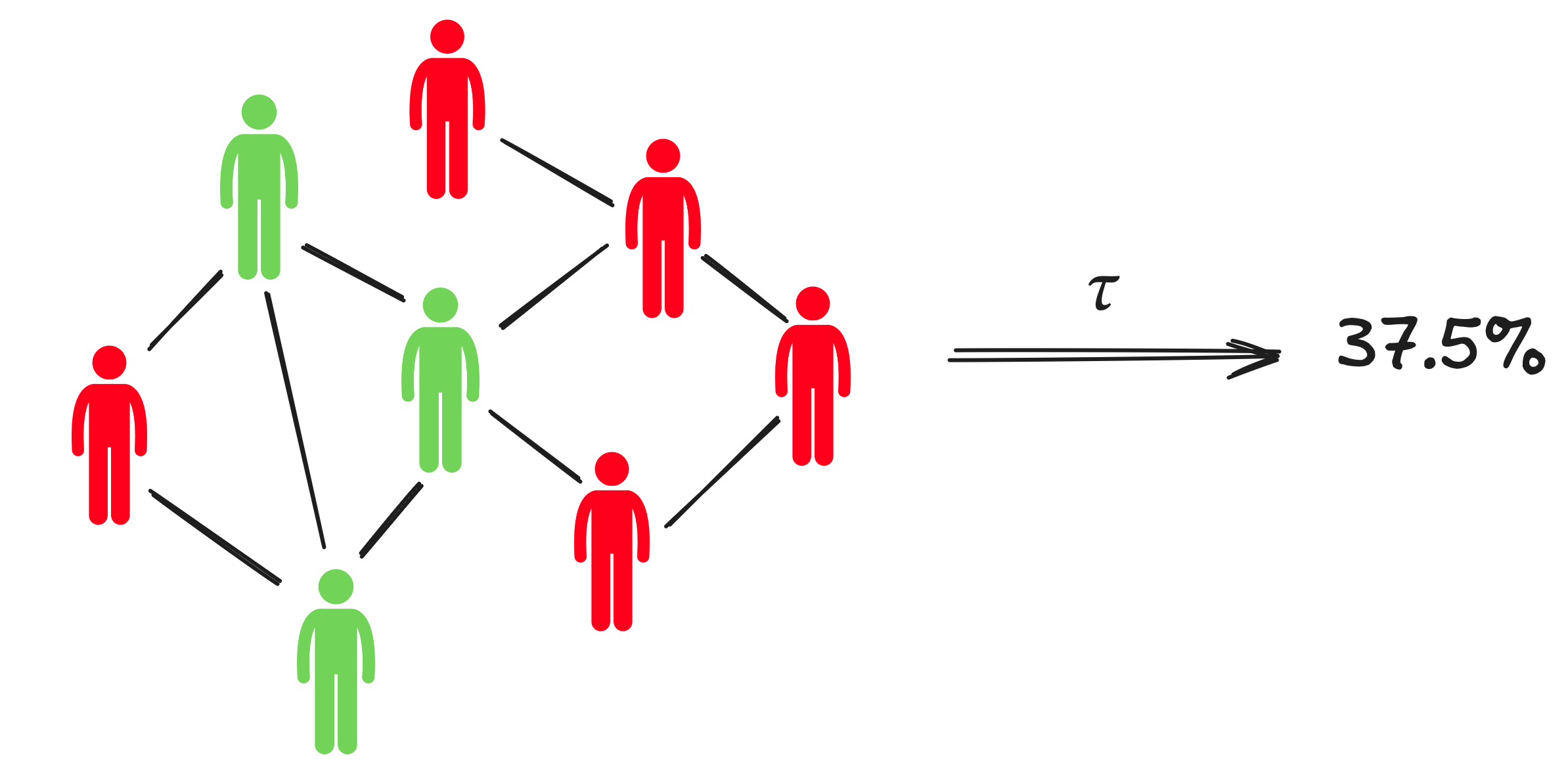
<p>Consider two SCMs; a base model \(\mathcal{M}\), and an abstract model \(\mathcal{M}^{\prime}\). You can think of \(\mathcal{M}\) as an ABM and \(\mathcal{M}^{\prime}\) as a simpler surrogate model. A \((\tau, \omega)\)-abstraction is a pair of maps \(\tau\) and \(\omega\). \(\tau\) maps variable assignments in the base model \(\mathcal{M}\) to variable assignments in the abstract model \(\mathcal{M}^{\prime}\). For instance, consider an epidemilogical ABM that tracks the infection status of individual citizens through time via a set of binary variables, and a simple ODE simulator that tracks only the total fraction of infected individuals through time. In this case, it is natural to let \(\tau\) simply count the number of infected individuals in the ABM on each time step. Note that this gives rise to a corresponding variable assignment in the ODE model.</p>

<p><img src="/assets/images/sir-tau-3.png" alt="An example $$\tau$$" /></p>

<p>Generally speaking, \(\tau\) should map the microstates of the ABM to macroscopic emergent properties that an expert would like to reason in terms of. We will assume from hereon that \(\tau\) is some fixed map that a domain expert has chosen.</p>

<p>Meanwhile, \(\omega\) maps interventions in the base model to interventions in the abstract model. Consider the previous epidemiological example. Our ABM may allow us to perform lockdown interventions to limit disease spread. In contrast, it is unclear what a lockdown intervention would look like in the ODE model as it does not simulate at the individual level. \(\omega\) is responsible for telling us what intervention in the ODE model corresponds to a lockdown. Unlike \(\tau\), it may be difficult for a domain expert to naturally specify an \(\omega\) map. We will come back to this issue soon!</p>

<h2 id="interventional-consistency">Interventional Consistency</h2>

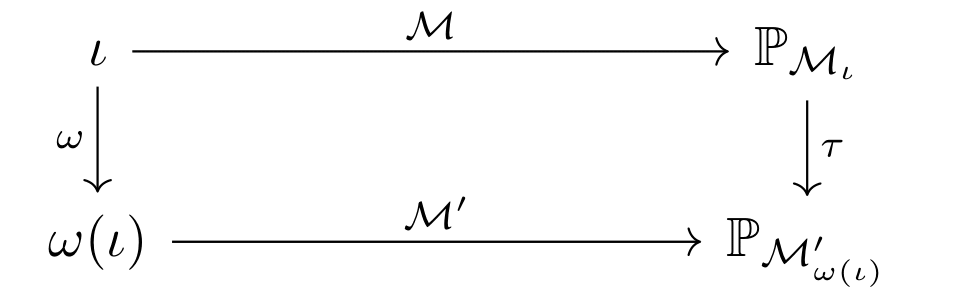
<p>What makes a good abstraction? Say we want to observe a macroscopic output associated with an intervention \(\iota\) in the ABM. We have two options. We could map \(\iota\) to its corresponding abstract intervention \(\omega(\iota)\) and apply it in the surrogate \(\mathcal{M}^{\prime}\) to obtain a macroscopic output directly. On the other hand, we could simulate \(\iota\) directly via \(\mathcal{M}\) to obtain a microscopic output and lift it to the macroscopic level via \(\tau\). Logically, we want both of these procedures to produce the same output. In other words, abstracting then intervening should be the same as intervening then abstracting! More formally, we want the following commutative diagram to hold for any possible base intervention \(\iota\)!</p>

<p><img src="/assets/images/IC_Error_diagram-6-1.png" alt="A perfect abstraction" /></p>

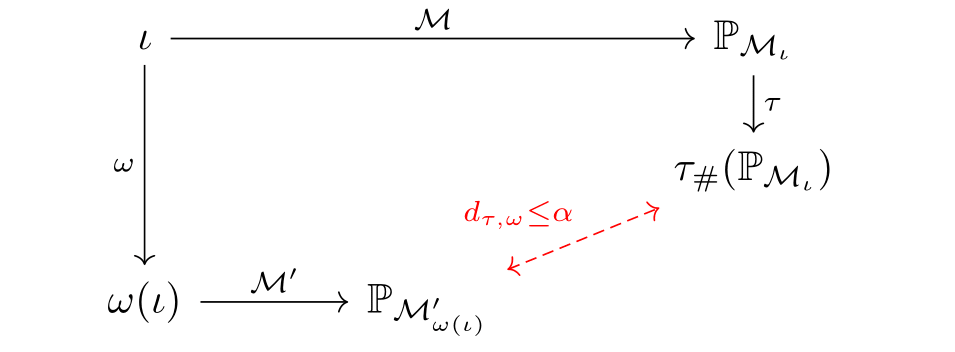
<p>In the diagram above, \(\mathbb{P}_{\mathcal{M}_{\iota}}\) and \(\mathbb{P}_{\mathcal{M}^{\prime}_{\omega(\iota)}}\) correspond to the interventional distributions associated with \(\iota\) and \(\omega(\iota)\) respectively. Commutativity is quite a stringent goal and one we are unlikely to achieve exactly for every intervention \(\iota\). That is, whichever surrogate model and intervention map \(\omega\) we choose, the interventional distribution attained by intervening then abstracting may differ from the interventional distribution attained by abstracting then intervening. Our goal should be to minimise the distance between these distributions as much as possible!</p>

<p><img src="/assets/images/IC_Error_gap_diagram-1.png" alt="Broken commutativity" /></p>

<p>This naturally leads use to the definition of abstraction error:</p>

\[d_{\tau, \omega}(\mathcal{M}, \mathcal{M}^{\prime}) = \mathbb{E}_{\iota \sim \eta} \left[ d\left(\tau_{\#} (\mathbb{P}_{\mathcal{M}_{\iota}}) ,\, \mathbb{P}_{\mathcal{M}^{\prime}_{\omega(\iota)}}\right)\right].\]

<p>Here, \(\eta\) is a distribution over base interventions, whilst \(d\) is a divergence between probability distributions. In words, the abstraction error measures the average difference between abstracting then intervening versus intervening then abstracting. The abstraction error depends heavily on the interventional distribution \(\eta\), which should be carefully chosen by a domain expert to reflect the interventions they care most about.</p>

<h2 id="learning-an-abstraction">Learning an Abstraction</h2>

<p>Recall that our goal was to learn surrogate models for ABMs. The abstraction error presents a natural metric for us to optimise. By setting the divergence \(d\) to the KL-divergence, we may jointly learn both a parameterised surrogate model and a parameterised intervention map that minimises the abstraction error.</p>

\[\begin{equation}\label{eq:our_loss}
    \phi^{\star}, \psi^{\star}
    % ) 
    = %\in 
    \arg\min_{\phi \in \Phi, \psi \in \Psi}d_{\tau, \omega^{\phi}}(\mathcal{M}, \mathcal{M}^{\psi}).
\end{equation}\]

<p>Here, \(\phi\) corresponds to parameters of the intervention map \(\omega\) whilst \(\psi\) corresponds to parameters of the surrogate model \(\mathcal{M}^{\psi}\). If we are careful in our choice of parameter families we can solve the above problem via stochastic gradient descent. With this in mind, let \(q_{\iota}(\cdot \; ; \; \psi, \phi)\) denote the density of the interventional distribution produced by the surrogate \(\mathcal{M}^{\psi}\) under the intervention \(\omega^{\phi}(\iota)\).  By choosing both parameter families so that the densities \(q_{\iota}(\cdot \; ; \; \psi, \phi)\) are tractable and differentiable with respect to \(\phi\) and \(\psi\), we can form Monte Carlo gradient estimates for the abstraction error using ABM outputs \(\mathbf{y}_{b}\) generated by forward-simulating interventions \(\iota_{b}\) sampled from \(\eta\):</p>

<!-- In particular, if we choose the surrogate family to be set of differentiable family of simulators, each with tractable density functions $$q^{\psi, \phi}$$, then we can optimise the abstraction error via stochastic gradient descent. More specifically we can form Monte Carlo gradient estimates for the abstraction error using ABMs outputs $$\mathbf{y}^{(b)}$$ generated by forward-simulating interventions $$\iota^{(b)}$$ sampled from $$\eta$$: -->

\[\nabla_{\phi,\psi}\, d_{\tau,\omega^{\phi}}(\mathcal{M}, \mathcal{M}^{\psi}) 
    \approx \frac{1}{B} \sum_{b=1}^B - \nabla_{\phi,\psi}
    \log
    q_{\iota_{b}}(\mathbf{y}_{b} \; ; \; \psi, \phi).\]

<p>Note that we do not need to forward simulate the ABM during training, as only evaluations of the surrogate densities \(q_{\iota}(\cdot \; ; \; \psi, \phi)\) are required. In other words, a batch of interventions \(\iota_{b} \sim \eta\) can be sampled and forward-simulated offline prior to surrogate training.</p>

<p>Note that the method we propose is not the only way to learn an abstraction. In fact, Yorgos recently published a <a href="https://proceedings.mlr.press/v236/felekis24a">paper</a> outlining an alternative approach based in optimal transport at CLEAR this year!</p>

<h2 id="the-importance-of-interventional-data">The Importance of Interventional Data</h2>

<p>To highlight the efficacy of our approach we conduct experiments using an SIR ABM designed to model epidemics. In short, this ABM consists of individuals connected by a graph. Individuals can be susceptible (S), infected (I) or recovered (R). On each time step, infected individuals have some fixed probability of recovering, whilst susceptible individuals have some probability of becoming infected based on how many of their neighbours are infected. We construct a set of neural network surrogates which sequentially process outputs from the classical <a href="https://en.wikipedia.org/wiki/Compartmental_models_in_epidemiology">SIR ODE model</a> that models the fraction of susceptible, infected and recovered individuals through time.</p>

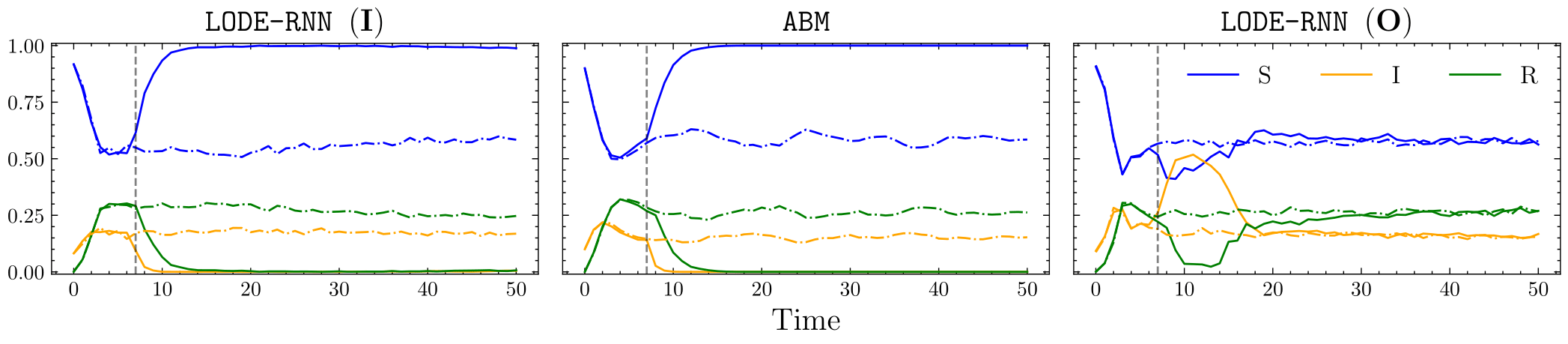
<p>For base interventions, we consider lockdowns that correspond to severing connections in the underlying graph of the SIR ABM for a fixed duration. For our surrogates, we consider interventions that directly edit the parameters of the underlying SIR ODE model for fixed durations. The image below shows three plots. Dot-dashed lines correspond to observational simulations where no intervention was performed, whilst solid lines correspond to simulations where an intervention was performed. The central plot shows a simulation of the SIR ABM, where a lockdown \(\iota\) (vertical line) was performed. The left plot shows a simulation of a surrgate model trained using the stochastic gradient scheme from the previous section, where the intervention \(\omega^{\phi}(\iota)\) was performed. Note that the surrogate matches the ABM very well! The right plot shows a similar simulation but for a surrogate trained with purely observational ABM simulations where no lockdowns were performed. As expected, this surrogate cannot replicate the effect of a lockdown in the ABM.</p>

<p><img src="/assets/images/LODERNN.png" alt="SIR simulations" /></p>

<p>For more details about our approach, check out the full <a href="https://arxiv.org/abs/2312.11158">paper</a>!</p>]]></content><author><name></name></author><category term="Recent Papers" /><summary type="html"><![CDATA[This blog post outlines a recent paper which I worked on with my fantastic collaborators Joel Dyer, Fabio Zennaro, Yorgos Felekis, Theo Damoulas, Anisoara Calinescu and Mike Wooldridge. This work is set to be published at NeurIPS 2024 - check out the full paper here!]]></summary></entry><entry><title type="html">Population Synthesis as Scenario Generation</title><link href="/2024/06/21/population-synthesis" rel="alternate" type="text/html" title="Population Synthesis as Scenario Generation" /><published>2024-06-21T00:00:00+00:00</published><updated>2024-06-21T00:00:00+00:00</updated><id>/2024/06/21/population-synthesis</id><content type="html" xml:base="/2024/06/21/population-synthesis"><![CDATA[<p>This blog post outlines a recent paper which I worked on with my fantastic collaborators Joel Dyer and Arnau Quera-Bofarull. This work was published at AAMAS 2024 - check out the full paper <a href="https://scholar.google.com/citations?view_op=view_citation&amp;hl=en&amp;user=bfaCPiYAAAAJ&amp;citation_for_view=bfaCPiYAAAAJ:YsMSGLbcyi4C">here</a>!</p>

<h2 id="synthetic-populations-and-abms">Synthetic Populations and ABMs</h2>

<p>Designing an agent-based model (ABM) invetiably involves generating a population of agents. Typically, modellers rely on datasets describing the underlying real-world population they are seeking to emulate. Armed with this data, the modeller can use their favourite algorithm to generate a population of agents with realistic statistics. For instance, many practitioners use iterative proportional fitting (which economists often call raking) to generate a synthetic population that has the correct marginal statistics using cross-table data.</p>

<p>So, what is the problem with this approach? It seems completely reasonable, but there are some issues. Firstly, the modeller might not have access to real-world data. This could be due to privacy concerns, or simply because the required data wasn’t collected in the first place. In addition, the agent-based model is never used to inform population design. Say you are an epidemiologist who has built an epidemic simulator for the UK. If you run your simulator and every individual gets infected within a single day, you may suspect that your synthetic population is not very representative.</p>

<p>In this work, we provide an altenative approach for generating synthetic populations which directly leverages the ABM. In what follows, we will think of an ABM as a stochastic simulator \(p\), which takes a set of structural parameters \(\omega\) as well as an population of agents \(\mathcal{A}_{N}\) and produces an output state \(x \in \mathcal{X}\).</p>

\[x \sim p(\cdot \mid \omega, \mathcal{A}_{N})\]

<p>Stuctural parameters represent global factors in the ABM which are not specific to any particular agent. Staying with our epidemic example, structural parameters may include vaccine efficacy or the infectiousness of the virus.</p>

<h2 id="generating-simulation-outputs-from-an-abm">Generating Simulation Outputs from an ABM</h2>

<p>For now, let us assume we have access to a domain expert, who has perfect knowledge of the structural parameters and the true underlying population. In this case, the process of simulating from our ABM may look as follows:</p>

<pre><code class="language-mermaid">graph LR
    expert("Domain Expert")
    struct("Structural Parameters")
    pop("Agent Population")
    sim("ABM")
    state("Output State")

    expert --&gt; struct &amp; pop
    struct &amp; pop --&gt; sim
    sim --&gt; state 
</code></pre>

<p>That is, we query the domain expert for the structural paramaters \(\omega\) and population \(\mathcal{A}_{N}\) then forward-simulate the ABM \(p\) to get an output state \(x \in \mathcal{X}\). Of course, a domain expert rarely has perfect information. As already discussed, the domain expert may have insufficient data to estimate population structure. Likewise, the domain expert may have imperfect knowledge about the structural parameters. In the worst-case the modeller may not even have access to a domain expert at all!</p>

<p>In our work, we aim to resolve these issues by replacing the domain expert in the diagram above with a <strong>proposal distribution</strong> \(q\) which aims to generate good sturctural parameters and populations. Instead of generating both the population and structural parameters jointly from the proposal distribution in one step, we generate structural parameters and population parameters \(\theta\) from the proposal distribution. The population parameters are used to parameterise an attribute distribution \(f\) from which the agent population is finally generated.</p>

\[\mathcal{A}_{N} \sim f(\cdot \mid \theta)\]

<p>Once we have the agent population and the structural parameters, we can proceed as before and forward-simulate the ABM to get an output state \(x \in \mathcal{X}\). Our approach is summarised by the following diagram:</p>

<pre><code class="language-mermaid">graph TD
    prop("Proposal distribution")
    param("Population parameters")
    attr("Attribute distribution")
    struct("Structural Parameters")
    pop("Agent Population")
    sim("ABM")
    state("Output State")

    prop --&gt; param &amp; struct
    param --&gt; attr
    attr --&gt; pop
    struct &amp; pop --&gt; sim
    sim --&gt; state
</code></pre>

<p>Of course, in order for this approach to work we need to pick a good proposal distribution. In learning the proposal distirbution, we suffer from similar issues to a domain expert that lacks knowledge or data. However, typically a modeller knows what kind of outputs they are interested in. For example, an epidemiologist may be trying to fit their ABM to a real-world time series \((y_{t})^{T}_{t=1}\), or they may be interested in searching for populations where the risk of contagion (number of infected citizens) is high. Our key idea is that the modeller’s preferences over state outputs can be used in conjunction with the ABM to learn a good proposal distribution.</p>

<h2 id="learning-a-proposal-distirbution">Learning a Proposal Distirbution</h2>

<p>In order to do this, we assume that the modeller/domain expert has provided us with a loss function \(\ell: \mathcal{X} \to \mathbb{R}_{+}\) describing their preferences over ABM outputs. For example, an epidemiologist trying to fit to a real-world time series of infections \((y_{t})^{T}_{t=1}\) may propose the following loss function:</p>

\[\ell(x) = \frac{1}{T}\sum^{T}_{t=1}(y_{t} - x_{t})^{2}\]

<p>where we have assumed the output of the simulator is a time-series of infections \(x = (x_{t})_{t=1}^{T}\). Alternatively, let’s assume the epidemiologist is interested in any outcome where more than \(\tau\) individuals are infected. In this case, the epdemiologist may choose the following loss function:</p>

\[\ell(x) = \mathbb{I}(\cdot \leq \tau)(x)\]

<p>where we have assumed the output \(x\) of the ABM describes the total number of infections over the simulation run. Here \(\mathbb{I}(\cdot \geq \tau)\) denotes the indicator function that reuturns \(1\) when \(x\) is less than \(\tau\) and \(0\) otherwise.</p>

<p>Given the loss function \(\ell\), we propose many algorithms for learning a good proposal distribution \(q\) by repeatedly sampling simulation runs from the ABM. Note that our approaches require no external data once the loss function has been defined! Next, I will walkthrough my favourite method for learning \(q\). You can check out other methodologies in the <a href="https://scholar.google.com/citations?view_op=view_citation&amp;hl=en&amp;user=bfaCPiYAAAAJ&amp;citation_for_view=bfaCPiYAAAAJ:YsMSGLbcyi4C">paper</a>!</p>

<h2 id="learning-a-proposal-distribution-through-variational-optimisation">Learning a Proposal Distribution through Variational Optimisation</h2>

<p>One way to learn a suitable proposal distribution is to take a variational approach. That is, we may consider a parameterised family of proposal distributions:</p>

\[\mathcal{Q} = \{q(\cdot \mid \phi) \mid \phi \in \Phi\}.\]

<p>In our experiments, we take \(\mathcal{Q}\) to be a normalizing flow. Then, to select an ideal proposal distribution \(q^{\star}\) from \(\mathcal{Q}\), we solve the following variational optimisation problem:</p>

\[q^{\star} = \arg\min_{\phi \in \Phi} \left\{
    \mathbb{E}_{\omega, \theta \sim q(\omega, \theta)}
    \left[\mathcal{L}(\omega, \theta)\right]
    - \gamma \mathbb{H}(q(\cdot \mid \phi))    
\right\}.\]

<p>Here, \(\mathcal{L}\) denotes a lifted loss over the structural and population parameters \((\omega, \theta)\) constructed using the domain expert supplied loss \(\ell\):</p>

\[\mathcal{L}(\omega, \theta) = \mathbb{E}_{x \sim p(x \mid \omega, \theta)}
\left[ \ell(x) \right].\]

<p>Roughly speaking, \(\mathcal{L}(\omega, \theta)\) captures the average loss experienced by the domain expert when \(\omega\) and \(\theta\) are used to forward-simulate the ABM using the approach outlined in the previous diagram. As a result, the first term in the objective above captures the average loss experienced by the domain expert when structural parameters and population parameters are sampled from the proposal distirbution \(q\).</p>

<p>Meanwhile \(\mathbb{H}\) denotes the entropy function. Thus the second term penalises the proposal distribution for accumulating too much probability mass on a small subset of structural and population parameter values. The trade-off between both terms is controlled by the scalar parameter \(\gamma &gt; 0\) which the modeller is free to choose. Note that a large \(\gamma\) will encourage greater diversity, whilst setting \(\gamma = 0\) causes \(q^{\star}\) to collapse to a degenerate distribution whose mass is concentrated on the pairs \((\omega, \theta)\) that minimise \(\mathcal{L}\).</p>

<p>As mentioned before, we use normalising flows in our experiments to define the variational family \(\mathcal{Q}\). As a result, we can readily solve the variational problem above by performing stochastic gradient descent on the paramaters \(\phi\), which correspond to network weights within the normalising flow.</p>

<h2 id="a-simple-example">A Simple Example</h2>

<p>To finish, let’s run through a simple example of our approach. We will consider Axtell’s model of firms. This model studies the evolution of financial firms over time. The model consists of a set of agents, who each belong to a particular firm at each time step. Each agent \(n\) works with some effort level \(e^{t}_{n} \in [0, 1]\) at time \(t\) and periodically reeavluates their situation at an agent-specific rate \(\rho_{n}\). In addition, each agent maintains a parameter  \(\nu_{n} \in [0, 1]\) describing their preference for leisure vs income. When reevaluating, agents decide between</p>
<ul>
  <li>adjusting their effort level</li>
  <li>moving to an existing firm</li>
  <li>or starting a new firm.</li>
</ul>

<p>You can find full details about the model in our paper. Now assume that we are a modeller interested in the following question:</p>

<p align="center"><b>Can an initially hardworking population become lazy over time?</b></p>

<p>To answer this question we first need to construct a suitable loss function. In this case, we can choose a simple loss function that measures the difference between the average effort of agents at the beginning and end of the time horizon:</p>

\[\ell(x) = \frac{1}{N}\sum^{N}_{n=1}\left(e^{1}_{n} - e^{0}_{n}\right),\]

<p>where \(x = (e^{t})_{t=1}^{T}\) is a time series of vectors describing the effort-level of each agent on each time step. We also need to define a parameterised family of attribute distributions. For the sake of simplicity and interpretability, we will assume that each agent’s features are generated independently and identically from a product of beta and gamma distributions:</p>

\[f(e^{0}_{n}, \nu_{n}, \rho_{n} \mid \theta) = \text{Beta}(e_n^0 \mid \varepsilon_{a}, \varepsilon_b) \cdot \text{Beta}(\nu_n \mid g_a, g_b) \cdot \text{Gamma}(\rho_n \mid \varrho_a, \varrho_b)\]

<p>where \(\theta = (\varepsilon_{a}, \varepsilon_b, g_a, g_b, \varrho_a, \varrho_b)\). There are no structural parameters in this model, so we don’t need to worry about them.</p>

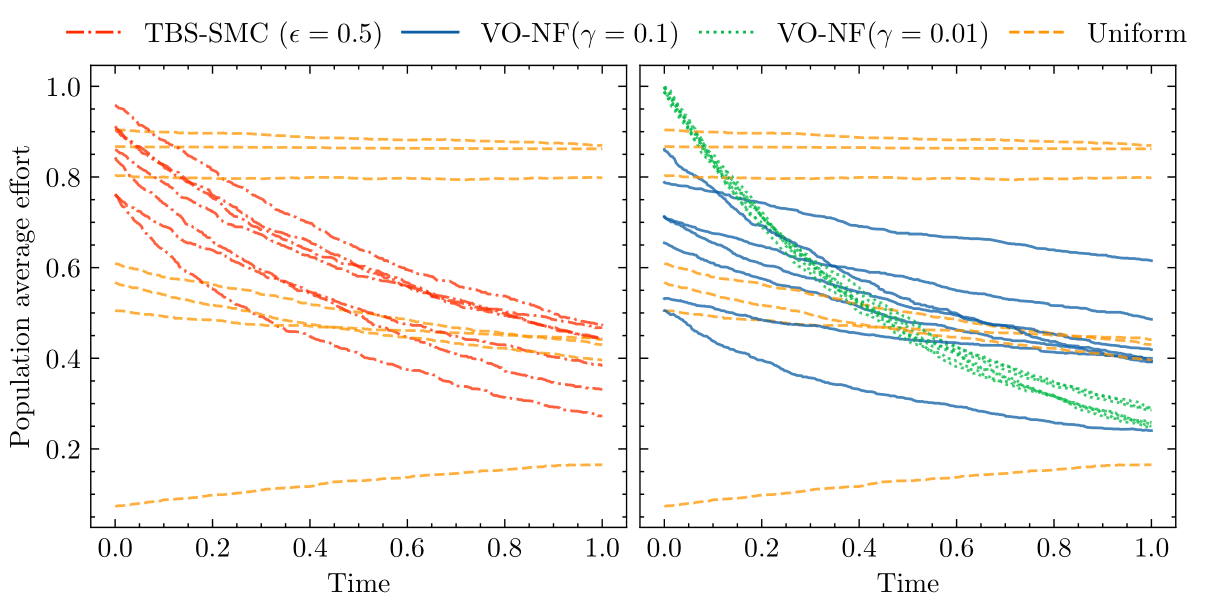
<p>We are now ready to learn a proposal distribution. The plot below shows the average effort of agents over time from simulation runs generated by different proposal distributions. In particular, the right-hand plot shows simulation runs generated by proposal distributions trained with our variational approach for different values of \(\gamma\). When comparing these runs to those generated from a uniform proposal distribution we see a marked difference. Proposal distributions trained via our variational approach consistently produce populations with decaying effort over time.</p>

<p><img src="/assets/images/axtell_effort-1.png" alt="Average Effort Over Time" /></p>

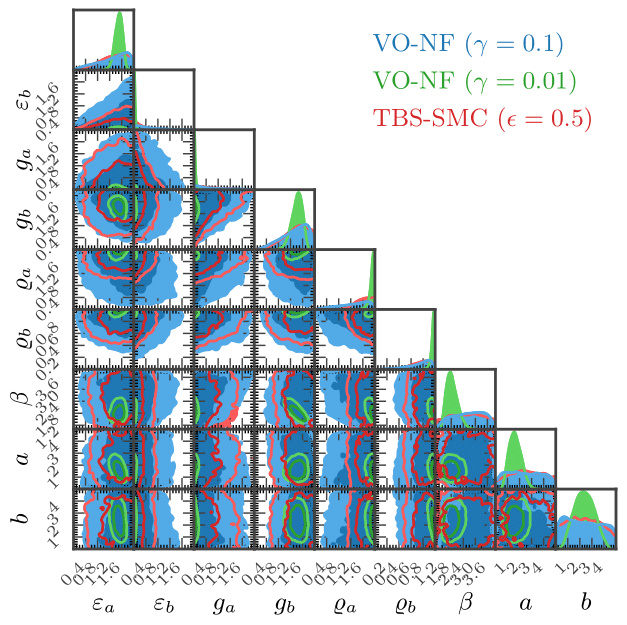
<p>Since our attribute distribution is simple, we can look at our proposal distributions and see what is causing this decay in effort.</p>

<p><img src="/assets/images/axtell_corner-1.png" alt="Average Effort Over Time" /></p>

<p>The blue and green plots correspond to proposal distributions we found using variational optimisation. We can make several observations immediately:</p>

<ul>
  <li>Agents need to <strong>begin with high effort levels</strong>. This is evidenced by the proposal distributions assigning higher density to larger/lower values of \(\varepsilon_{a}\) and \(\varepsilon_{b}\) respectively.</li>
  <li>Agents need to <strong>reeavluate their position on a relatively frequent basis</strong>. This is manifested by relatively high/low densities assigned to \(g_{a}\) and \(g_{b}\) respectively, which translates to a left-skewed distribution over \(\nu_{n}\).</li>
  <li>Agents need a <strong>strong preference for leisure over income</strong>. This is manifested by high density assigned to both \(\varrho_{a}\) and \(\varrho_{b}\), which increases the mass assigned by the gamma distribution to higher values of \(\rho_{n}\).</li>
</ul>

<p>Check out the full <a href="https://scholar.google.com/citations?view_op=view_citation&amp;hl=en&amp;user=bfaCPiYAAAAJ&amp;citation_for_view=bfaCPiYAAAAJ:YsMSGLbcyi4C">paper</a> for more examples!</p>

<h2 id="code">Code</h2>
<p>If you want to apply our framework in your own research I highly recommend checking out <a href="https://github.com/joelnmdyer/synthpop">SynthPop</a>, which is a Python package we developed for precisely this reason!</p>]]></content><author><name></name></author><category term="Recent Papers" /><summary type="html"><![CDATA[This blog post outlines a recent paper which I worked on with my fantastic collaborators Joel Dyer and Arnau Quera-Bofarull. This work was published at AAMAS 2024 - check out the full paper here!]]></summary></entry></feed>